
Even by the low standards of Cognitive Intervention Training Program Class 39, Paycheck’s reason for getting remanded to admin-seg was particularly stupid. Not surprising, mind you. An unrepentant smoker, he was a known thief of just about anything not welded to the ground. Even when compared to the other ethical shipwrecks in the program, his tendency to deploy sticky fingers was well beyond the norm. I lost count how many times he got into fights over his inability to comprehend norms of ownership — at least a dozen. Paycheck wasn’t going to be learning any lessons. Having spent more than forty years in the Texas Department of Criminal Justice, he’d already learned the ones that mattered to him. What he cared about was getting high. If that meant he occasionally had to get touched up by someone a third his age, so be it.
I almost never interacted with him. I tried a few times, but there just wasn’t much overlap in our interests. His thievery only impacted me when we would go to the filing cabinet to acquire art supplies for some project Ms. G- had assigned us to find that the markers (or the ruler, or the colored pencils, or the rolls of poster paper, or the…) had vanished. None of the teachers were ignorant of what was going on. There was a camera in the classroom, and it worked just fine. On a few occasions they had sent officers to Paycheck’s cell to search for the missing supplies. This yielded a few items on occasion. The problem for the guards was that Paycheck usually sold his acquisitions almost immediately, because he wanted to get high almost immediately. I swear, by late September, the dope boys had to have had enough stationery supplies to have opened an Office Depot franchise.
This time, however, Paycheck’s grasp had outreached his means. Some kind of way he had managed to sneak into the GRAD classes before the rest of us were let off the wing, and he had succeeded in prying open the locker containing the fifty or so brand-new composition books which were to be given out that afternoon. This would have been a real payday for him. When I first arrived in the TDCJ, friends and family in the free world could send a limited amount of stationery supplies from approved vendors like Amazon. The commissary sold lined notepads for $1.25 and notebooks for a bit more. I’m not sure who makes what exactly, but all of the items bought at the commissary bear the imprint of the Hobby Unit, a women’s prison in Marlin. The administration stopped the outside purchases more than a decade ago. Once their monopoly was secured, they jacked the prices of notepads up to more than $5 a pop. These composition books were therefore worth at least three bucks on the black market, if Paycheck had managed to get back to the wing with them.
Unfortunately for our master thief, fifty composition books is a rather large package to try to sneak around, and one of the guards in the hallway noticed that he had something conspicuously massive inside the mesh bag he had hoisted over his shoulder. A strip search ensued, and just like that, Class 39 was down to twelve members, exactly half of what we’d started with. With only a month to go before graduation, the betting had already begun on who was likely to wash out before the rest of our sorry party stumbled across the finish line.
It wasn’t just the prisoners who were tapping out. Ms. W-, the teacher for the RPD section of the programming, quit her position abruptly and put on guard’s gray. We’d see her occasionally in the main hallway, baton in hand. Some of my peers took this as some kind of grand accomplishment. Little Mike, in particular, seemed to think he was almost personally responsible for making her quit. Little Mike was eighteen. Eighteen-year-olds are, I have discovered, a rather exceptional cure for nostalgia. The administration quickly replaced her with Ms. M-, a new hire who was supposed to begin a few weeks later with Class 41. She seemed nice enough, if perhaps a tad intimidated — an entirely reasonable position, to my mind. We watched a lot of movies during her class. To her credit, she did try to find films that contained themes relevant to subjects we’d studied in class. I remember a scene from Clean and Sober, where Michael Keaton’s character is sitting in a waiting room with several other patients. He’s looking around at everyone, and the expression on his face clearly says: what the hell am I doing here? Is this what I’ve become? I could relate.
We were all counting down the days. The last time I’d experienced a countdown where I wasn’t dreading the passage of time was, I realized, my high school graduation, which took place sometime in the Pleistocene, as best as I can recall. The unit-level administration was ramping up the policy of mass punishment being pushed from the main offices just down the highway. The sergeants seemed almost apologetic, but the message from the center was simple: if prisoners were seen on camera smoking in the dayroom, guards were going to lose their jobs. Given that the department didn’t really have enough officers to impose this level of control, we were being told to police our own, or risk losing visits, commissary privileges, and class time to short lockdowns. From a certain, dispassionate view, it was interesting to monitor the ways that my compatriots were reasoning their way through the idea of collective punishment. We had all been told for years that we were solely responsible for our moral failings, that any attempt to blame our actions on contextual or environmental influences was merely an attempt to evade responsibility and accountability. Now we were being told the exact opposite, that we had to be the positive context for all of our peers, or else we would suffer the same fates as them.
Naturally, violent confrontation with the lawmen was seen as the response of first resort. This, unfortunately, does sometimes work in my world. COs aren’t paid enough to be hard cases, so if the majority of them see a group of angry malcontents acting in unison, they are going to tend to find somewhere else to be. The Crips had already tried to impose order in the day room and eventually relented when half of their brethren got kicked out of the program for violently assaulting the smokers. As the number of days we spent on lockdown rose, however, other groups began banding together. A Blood named Mustafa got into a shouting match with a lieutenant in front of the chow hall and ended up slugging one of the guards that stepped a little too far into his personal space. That, of course, got us locked down.
“That shit didn’t even happen on the wing,” my friend Lucky groused the following day, once our 23:59 was over with. “It’s like there’s no way to win. If we don’t do nothing, the tuneheads get us celled. If we put them in a bowl, they lock us down for beating them up. If we go after the laws because the whole situation is fucked up, then they really lock us up. I don’t get what I’m supposed to do.”
“For starters, you have to completely eliminate that third option. Terrorist tactics always strengthen despots,” I said, dumping my two cents onto the table. “Violence is always used to justify an increase in repression in the name of security.”
“That’s bullshit, too, though,” Polar Bear responded. “All that really is an argument for even more violence. Mustafa just didn’t go far enough. You start sending guards out in body bags, they gone change they song real fast.”
“The only way that logic works is if you are actually strong enough to overthrow the system. And I’m not talking about the Ellis Unit admin, or even the TDCJ. I’m talking about all the way up. I know you think highly of your boxing game, but trust me, the National Guard isn’t worried about your right hook.”
“Shit, they ought to be. And last I looked, there are twenty of us for every one of them. I like them odds.”
I didn’t, but I recognized that he was just angry, not discussing any sort of real conspiracy to overthrow the TDCJ. Still, it did make me wonder about protest movements. You can certainly find examples where someone like Ghandi or Havel or the whole Polish Solidarity movement found success largely due to the moral superiority they possessed over their foes. It was also true, however, that those foes themselves had a moral compass — that’s why they were able to recognize that their time had passed, and change appeared to be inevitable. There has to be some shred of human decency in one’s opponent if they are ultimately going to order the tanks to turn back, right? Some kind of voice that whispers: the only way I can win this contest is if I kill more people than I can stomach. The protestors in Hong Kong a number of years back had no such opponent, and they got crushed. Maybe if they’d had some javelin antitank missiles, Polar Bear’s argument went, they’d have altered the CCP’s calculus. But what then? It’s escalation all the way up, a contest of raw power. But of course, repressed people seldom have those kinds of weapons, or the skill to wield them tactically. Powerful people can read history, too. The lessons of the past fifty years aren’t lost on them. They know that they generally lose only when they give in — which they will no longer do, because they know we don’t have those missiles I mentioned. Even if somehow Polar Bear managed to acquire the penal equivalent and made the TDCJ flinch a little, the right-wing media ecosystem would rationalize and justify his death, and enough Texans would buy into this that the harsh tactics that would inevitably result would seem to be entirely reasonable. As Lucky said, there didn’t seem to be any way to win. Those of us just trying to survive here were going to get the short end of the stick, no matter what. All that was left was to find a personal philosophy that made being crushed somehow acceptable.
Such was the strength of my desire to avoid the politics and the general aura of desperation that pervaded the dayroom that I signed up for Kingdom Brawlers, a Christian-themed workout program. A couple of field ministers had been trying to get the wardens to approve a chapter for the CITP participants for months, and they finally signed off on the plan in early September. I attended the first class. My hope was that this would be a good excuse to get away from the wing for a few hours each week and maybe get in a good sweat. I knew that there would be some ideological indoctrination, but I felt that I had put up with that sort of thing for more than eighteen months in the Faith-Based Pod at McConnell, and my tolerance levels were therefore pretty high. The program would take place in the gym reserved for G4/G5 offenders. We met for the introductory session on the second Saturday in September.
As soon as the twenty or so of we potential brawlers entered the gym, field ministers divided us into two groups: Gadites and Grongards. The entire program would be a competition between these tribes. Most of these “challenges” would consist of physical activities, but there would be some mental contests as well, such as memorizing certain biblical passages and the recitation of a creed of some thirty lines. The instructors were also open to what they called “snap challenges”, which were impromptu contests proposed by soldiers.
The majority of the first two hours of class were spent on a few sermons which the ministers had prepared, and the repetition of what I suppose were meant to be inspiring slogans (“All muscle, my hustle — for Jesus!”) I listened for long enough to locate this particular version of the faith on my ideological map. It was one I’d heard before, a mostly doctrineless, androgen-infused culture war vehicle that has been gaining steam over the past few years. The end product is a man who claims to see the world through “spiritual eyes”, by which they actually mean, right-wing authoritarian. This is a Christianity deprived of (what I thought were) the core elements of mercy, kindness, and forgiveness — and don’t even talk about turning the other cheek; this version of the Numinous has no patience or time for pussies. It doesn’t seem to have much room for emotional literacy of any kind. Blessed are those who choose normative male alexithymia, for they shall inherit the wasteland.
I’d heard much of this sort of thing before, so I mostly tuned the ministers out and memorized the creed. I decided to change two words, to better fit my position vis-a-vis the god hypothesis. Instead of the word “soul” I went with “spirit”, which, I suppose, is almost as metaphysically doubtful, but at least it could be semantically viewed as slightly less problematic for we secular types. I also replaced the word “god” with “my fellow human”, in the context of vowing to be true to something greater than myself. I felt these alterations were miniscule, and, after all, the poem was supposed to be a creed, which by definition is a statement of belief. You can’t speak a creed if you don’t believe in it, not if you are being honest.
Once the sermons were complete, we were separated into our tribes, our “families” in the parlance of the program. Each team nominated a coach, who would be our leader. We spent an hour or so establishing baselines for each type of competition and decided who would be our representatives for each of the challenges on the second day of class.
I made the mistake of suggesting a couple of snap challenges to our coach, Bam. Once I’d explained them to him, he grinned and went to speak to the field ministers.
“Okay, listen up guys: the Grongards have issued a pair of day one challenges, and I think I’m going to approve them,” shouted Minister R-. “Cuz that’s the spirit of the Kingdom Brawlers. We show up on day one and go hard in the paint. Bam?”
“I’m betting none of these so-called Gadite niggas even know what a Gadite is. How you gone rep something you cain’t even define?”
“Ooh, tough words! Anybody over that got a response?”
There were a couple of attempts to fish an answer out of the ministers, all of which were unsuccessful. I was called upon to supply the meanings of the name of each team, though I tactfully omitted the fact that both were groups that had been annihilated in battle. I still find the selection of these names to be odd. Aside from both of them starting with the same letter, I can’t imagine why the program’s designers had gone with these particular groups. At any rate, we Grongards were given points for the first challenge, and my stature rose a little bit.
“Here’s the next challenge: anybody got they creed memorized yet?”
“You said we had two weeks to memorize that shit!” Roberto protested.
That was true. I probably should have been content with showing off with the first challenge, but I figured that as one of the oldest competitors, I probably wasn’t going to be winning too many of my physical challenges, and any points I could manage to grab would be appreciated. After a short debate, the ministers and coaches decided that I would get a couple of points added to my first physical if I could recite the creed.
I don’t think the majority of the participants even noticed my minor alterations, but a couple of the Gadites began to make noise. I was called on to explain myself, which I did in what I thought was a kind, ecumenical manner. I reminded the hardliners that we had been specifically told that the program had been advertised as being open to people of “all faiths and none”. I am not sure if the developers had actually thought about the fact that any creed that professed a faith in a deity automatically meant that people of no faith would have to lie in order to participate — and honesty was one of the core values of the program. I should stress that hardly anyone had a real problem with my alterations. I was on pretty good, cordial terms with just about everyone on my wing. One of the few people about whom this could not be said was, unfortunately, on the Gadite team, and he pitched a fit. That was kind of Puppet’s thing, pitching fits. I could tell that the coaches and field ministers were ready to turn the page on the argument after a few minutes of minor sniping, but Puppet wasn’t letting it go. It was a little endearing, watching the ministers defend me, a person whose position on their belief system was not positive, against a fellow and apparently ardent coreligionist. A few of them were starting to get that look men sometimes get when they are starting to daydream about punching someone square in the jaw when I decided enough was enough. I stood up and told one of the ministers that I was done — that this wasn’t what I had signed up for. Several of the guys said that Puppet should leave, but, really, even being a part of something that required the memorization of a creed made me uncomfortable, and I had already started to think that joining the club had been a mistake. One minister asked if I would mind just saying the creed as it was, out of a spirit of “brotherhood”. If I had needed a final straw, he’d located the perfect one in the heap. I said that I would not, that I had my principles, and in any case the spirit of brotherhood would have probably been better exemplified by valuing me as a person more than a collection of words written on a piece of paper. But then, that’s a pretty good practical definition of religion, to my mind.
I was a little disappointed, but I reasoned that I could just as easily do burpees in my cell as I could in the program.
In the end, the CITP chapter of Kingdom Brawlers lasted less than three weeks. The early morning hours killed attendance, and after a couple of sessions where only a handful of competitors showed up, the field ministers shut it down. I think they misunderstood the nature of the men they were seeking to shepherd, honestly. We hear so much bullshit in the Hole, we tend to grow some pretty serious antibodies to nonsense. When I asked a number of the former participants why they quit, they mostly told me that they had just wanted to be pushed to work out harder, which had been my own desire. I took no pleasure in the ignominious death of the program. Okay, maybe an eensy little bit. If only all zealotry died so quickly.
My final few weeks in the program did see at least one welcome development. In every seg wing found in this state, you will find a small number of men who once attempted to escape. Many of these prisoners have served well over the ten years required by policy. I’d known a dozen or so such men over the years, and, because of my high-profile tag, had often been placed on the “movement list” with them, an unfortunate designation that required those so labeled to be shifted to new cells every few days. While everybody had hopes of one day being released back to general population, most of these men harbored the fear that they would serve the remainder of their sentences in the Hole — and in the case of the lifers, the rest of their existences. For the last few years of my time in seg, rumors had abounded that the TDCJ’s “2030” reform plan would see the eventual release of many of these men. There was no evidence of this during the first five or so months of my time in the CITP. That was, until Boneyard and Nanoo arrived from a prison in north Texas. Both had spent considerably more time in admin-seg than I had — almost thirty years in Bones’ case. Both had the almost translucent skin typical of subterranean creatures, and they were in for a couple of months of painful sunburns before they could even be considered to look healthy again, a thing I knew from personal experience. Over the next few weeks, three more ultra-long-term convicts with the EX Security Precaution Designator arrived at Ellis. This gave me hope for many of my friends who had joined gangs when they were young and fresh in the system, and who had ended up being confirmed and sent to seg for eternal terms.
Prison teaches you all kinds of lessons, some of which are simple of enough to be distilled into aphorisms. If there’s one axiom that I keep coming back to more than any other, it is this: don’t get your hopes up. Mother Prison giveth, and Mother Prison taketh away. Boneyard ended up being fine — anyone daring to call themselves something like that probably ought to have a resolute soul, and he’d kept the fire burning inside during the long years of darkness. Nanoo wasn’t so wrought. He never lost that deer-in-the-headlights look of the newly arrived, and we all worried about him almost from the start. After the first few days, he stopped coming to the day room. The word went around that he was a “house mouse”, a cellie that never gave his bunkmate “cell time” — alone time. Many of us tried talking to him, but he was intransigent. There was nothing in the dayroom for him, he claimed. I don’t think he made it two weeks; for some reason, I neglected to write down the date of his departure. I know he was gone by the start of October. I never knew exactly why. Sergeant M- simply told us that he had gone to lunch and requested to be remanded to lockup, claiming his life was in danger. Wilson, another such prisoner, got into a fight with his cellie on his third day, and was similarly remanded. Only about half of the men in this group were still on the wing by the time I graduated. I have no idea how many of them made it through to their own graduation. I can’t imagine what that would feel like. I’ve known fear — any prisoner who claims to have never been afraid in these places is lying. But that kind of terror — the kind that would send a person flying back to seg after spending more than twenty years in that hell — is foreign to me.
I never got to experience any kind of graduation ceremony when I completed my BA and MA in prison. I wasn’t under any illusions that the ceremony for CITP 39 was going to be some kind of grand affair, but I admit I was definitely looking forward to 17 October. We were told that there were going to be brownies and punch, which may not sound like much to you, but these are rare treats in PrisonLand. I figured putting up with Orlop for three months was worth at least some sort of acknowledgement. The main reason for my excitement — beyond the obvious fact that once I’d completed the program, I would officially be a population-level offender — dealt with the guest list. Certain classes that one completes in the TDCJ permit visitors to attend the graduation ceremony. Since these are contact visits (i.e., not separated by glass, as every last one of my visits in the system had been heretofore conducted), generally this means two immediate family members. Unlike in many states, here in Texas, only such immediate family members or spouses are permitted to physically touch prisoners. Ellis was an old redbrick unit, however, and sometimes redbrick units preserve policies from the ancient days that somehow get grandfathered into sustained existence. One such policy at Ellis was that the wardens would allow anyone on one’s visitation list to attend graduation, family or not.
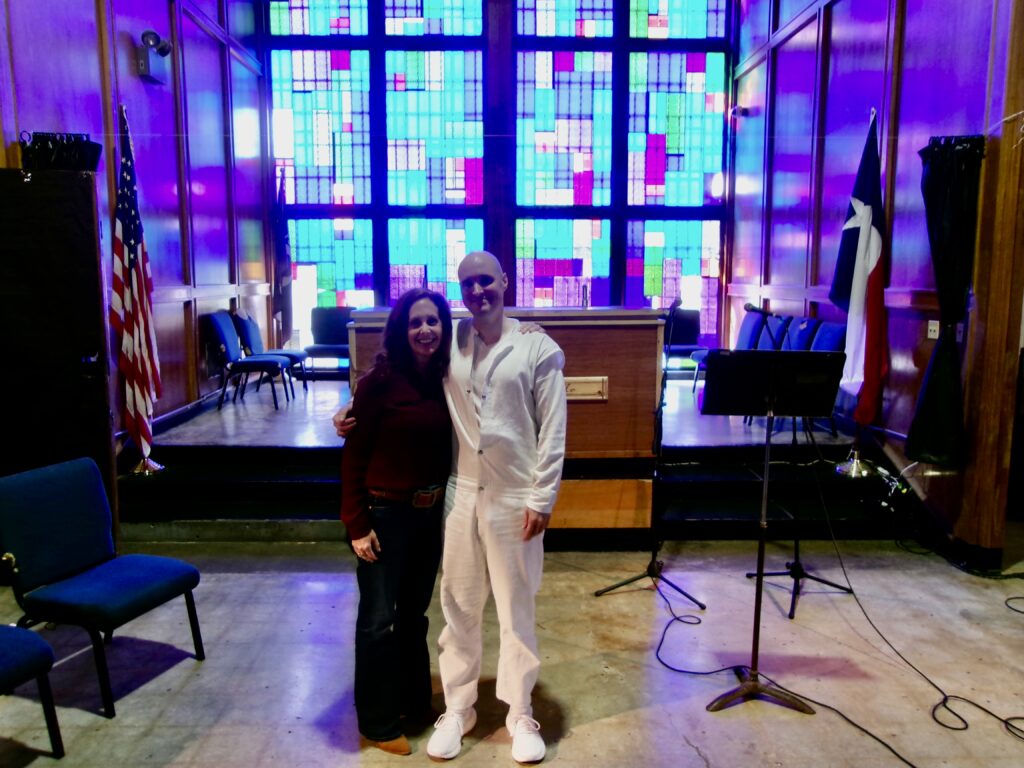
This presented me with a real opportunity — and a dilemma. I had not touched my father since I had left for Mexico in 2004. I had never touched my stepmother. They would have been the obvious choices. But it was also true that once I arrived at my new unit, I would have contact visits with them whenever they wished. The graduation ceremony presented me with what was likely going to be the only chance I would ever have to embrace my best friend, a woman that had been pretty substantially in my corner since 2008. You know her as the executive director of this site, and MB6 (and my writing career, such as it is) owes much to her guidance and massive reservoir of patience. Even during the worst days of my near brush with the medicalized gibbet, I’d never been able to so much as shake her hand, and it seemed obscene to me that after so many years of being separated by glass, I might never be able to give her a hug.
I talked the whole thing over with my dad and told him how I was anguishing over this choice. It seemed supremely shitty to make him wait a few more weeks for a reunion we’d been yearning for for decades. I mean, who does that? On the other hand, was I really going to die one day still bemoaning the fact that I’d never touched my best friend? Prison seems to confront me with intractable, impossible scenarios like this pretty regularly. I understand we are here to be punished. I get it. This doesn’t change the fact that it is profoundly evil to prevent people from holding hands in the name of security, when damned near every other state in the nation has decided otherwise.
The metric I ended using was an old friend: what was I going to regret missing more? From that angle, things seemed a bit clearer. That didn’t mean I felt great about telling my father he’d have to practice a bit more patience. Neither of us really understood why such a choice was necessary. I could spend fifty life sentences in this place and still not be able to explain it to you.
The final weeks of class were a study in wasting time. The developers of the CITP knew that the average prisoner was going to miss classes on a semi-regular basis — seg inmates were not the types of kids who received perfect attendance awards in elementary school. The administrators built some cushion into the calendar, though they neglected to tell us of this fact. A number of comments made by Ms G- alerted us to the exact manner in which the Windham School District kept track of our progress. I admit I didn’t pick up on this immediately. I tended to take out a book when my peers attempted to divert Ms G- down Tangent Lane. I only clicked back to the conversation when I noticed Doughboy getting irritated. I don’t think teacher meant to divulge this, but we had some military-grade pesterers in CITP 39, and they were able to drag it out of her that there was a hard number of hours that we individually had to accrue, or else nobody would graduate. Once we figured out that this number was around 220, we began to nag her for our counts — and when she wouldn’t tell us, out came the calendars and the calculators. I hadn’t missed any classes, so I realized pretty quickly that I was well over the necessary point. When I quietly mentioned this to Ms G-, she very quickly responded that I still had to attend, that if I missed too many days, she would have to flunk me. It felt like a prerecorded response, like this was an issue she dealt with every class. It still irritated me, though. I wasn’t threatening to start skipping. My intent had been to see if some of us could bump the date forward, and to try to find out exactly how far behind the laggards were. I could tell she was stressed, so I didn’t press the issue.
Once the reality of the situation had percolated down into the consciousness of my classmates, however, they weren’t so calm.
“So, is you really telling me that I got to wait for all of these lazy hoes that choose not to come to class?” Danny Boy asked.
“Everybody has to accumulate their hours,” Ms G- responded wearily, clearly regretting that she’d ever mentioned the number 220 a single time in her life.
“But I’m done. I came for yo lame ass lessons, I played yo puzzles, I drew them posters. Why I gotta wait for some lazy ass motherfuckers?”
If Ms G- had found us unfertile soil for her lessons before, now she was tossing her seeds on concrete. “I got my hours, ask someone who ain’t” became a pretty standard response to pretty much any question she asked. I felt bad for her but also annoyed that I’d had to spend an extra two months in a mostly pointless program just because the guards refused to make the worst of us attend class regularly. I thought of all of the people that had failed out and wondered how many might have made it through to graduation if the standards had been individualized. This was not a minor concern. Over the course of October, several more of my classmates flunked out, including two that had the hours necessary to graduate. By the time it was all said and done, only nine of us made it: Bam, Danny Boy, Greg, Catracho, Roberto, Mario, Doughboy, Little Mike (somehow), and me. Lucky, a guy I genuinely liked, failed out the week before graduation when he fell out of his bunk and hit his head on the sink. He wasn’t high, but when prisoners go to the hospital with that story, the assumption is that they were tuned out of their minds. By the time the investigation cleared him, we had already graduated and he had to retake the entire program.
The ceremony was to take place in the chapel, a portion of the facility that had thus far been off-limits to us. Being allowed to enter felt like some kind of transition, finally, like we were now human enough to be allowed to need the consolations of religion, if we so desired. There is no direct access to the chapel from the fences, meaning the friends and family that had been approved by the wardens to attend had to be escorted from the administration wing through the length of the prison. This meant that the unit had to be placed on lockdown for several hours. It wasn’t always thus. A couple of years back, they simply closed down the central hallway to traffic and left the prisoners in the dayrooms alone. Since all of these dayrooms had windows facing the hallway, however, this gave the sexual deviants amongst us ample opportunity to ogle and catcall the guests. Apparently one of the men finishing up his GRAD time hadn’t cared for the manner in which someone had commented on his sister’s anatomy and had ordered some of his homeboys on that wing to stab him up. After this, it was decided that perhaps it would be better if the dayrooms were left vacant. I, for one, was relieved to learn this. It would be difficult to ignore the norms of these halls if some degenerate directly insulted a female friend or family member. If someone let that slide, it would pretty much be open season on them.
I was keenly interested to hear what Dina would make of her journey into the prison. She had visited many facilities over a couple of decades, both here in Texas and across the nation, but visitation rooms are the most carefully curated portions of these sites, the cleanest parts, the sections with the nicest officers, the areas where maintenance orders get completed quickly and where the denizens of Tartarus are on their best behavior. It’s a pretty rare thing for citizens to get to see the living areas of an American maximum-security prison, and I was eager to learn what a pair of freeworld eyes would make of it all.
We graduates were let out of our cells at 8am and were ushered into the dayroom on B3 to wait for our guests. It was a cool morning, the first such pleasant weather we’d had since the misery of the summer. The nine survivors of CITP 39 were in an ebullient mood, even Catracho, whose family was in Honduras and were far too poor to make the trip. I thought at the time that several of the guys were making an attempt to bury some low-grade anxiety. I suppose I could have been projecting a bit — I know I felt a little nervous. Nothing is ever final in prison until it happens. We all know how Charlie Brown feels each time Lucy yanks the football to the side (I actually know someone that has this scene tattooed onto his bicep). There was a small part of all of us that half-expected some random admin-wing sergeant to come strutting down the hall to tell us that graduation had been cancelled.
I know that, for me at least, this was the first time I was going to have meaningful human contact since 2005. I was never what you might call particularly socially graceful. I mimicked such people fairly well when I was younger, but inside it often felt formulaic: situation C calls for behavior P, unless M or N, in which case…. I had been reeducating myself on interpersonal behavior since April, but prison dynamics are not freeworld ones. Here, personal space is protected, and one’s defense is always on one’s mind. Even within this more limited set of options, I’d found a number of social situations perplexing, even greetings. Does this person shake hands? Do they clap hands? If so, what is the style? Some people like to clap and then lean in, where shoulders touch, or maybe an arm gets extended to complete a kind of manly embrace. There are all kinds of cultural codes here that you have to memorize — and you’d be amazed at the complexity of the clasps in this place, especially amongst the gangs, who often use such greeting displays as evidence of membership. I’d been noticing more and more the little strangenesses that my years in seg had woven into the tapestry of my being and trying to pick these apart as I rejoined the community of men. I guess I wasn’t overly worried about all of this, just mindful that I’d adapted to a place that was extraordinarily rude and was about to share actual physical space with someone I really didn’t want to look weird to. I suppose I’m really writing the above for posterity, a simple note to a possible kinder future: prisoners in this era could become so damaged that an embrace could become a source of anxiety. Make of that what you will.
The administration finally allowed our guests into the facility a few minutes before 9am. Several guards escorted them. Most of these citizens broadcasted the same body language: roving eyes, slightly hunched shoulders, a walk that seemed a bit rushed. Dina, to her credit, seemed more curious than afraid. It made me proud.


You can see the paperwork given to us at graduation above. We were let into the chapel a little past 9am. The Ellis Unit church band played us in. The chapel itself is a rectangle of perhaps eighty feet by fifty. It had fifteen rows of pews, divided down the center by an aisle. Our guests were seated on the left side, while we were ushered to the right. We knew that we would have to endure the ceremony before we would be allowed to join them. I suspect we all harbored the certainty that each of the speakers would therefore stride to the lectern with half a tree’s worth of notes in hand.
I have to admit that I was impressed by the whole affair. Usually, the TDCJ is nothing if not underwhelming: no matter how much you lower your expectations, they never fail to disappoint them. I would never try to sell you on the idea that they put on a grand affair, but it was clear that several of the guests were genuinely proud of us. The band was earnest. One of them later told me that he’d known a buddy of mine from Coffield and had volunteered to play that day just to get a chance to congratulate me. These sorts of displays of kindness mean a great deal to me, and I shook his hand with real meaning. The Nigerian chaplain gave a rather interminable invocation, but all of the rest of the speakers managed to give fairly succinct messages. Chris Carter, Director of the Rehabilitation Programming Division, showed up, and I was able to meet him after the ceremony ended. He must have been told something about me beforehand, because he mentioned that I had been waiting a long time for that moment, and he wished me well. It is a little unnerving to have someone like him know my name, but I suppose my story is somewhat atypical and perhaps more than a little memorable.
The chapel possessed a set of mostly blue stained glass, which sat right behind the stage. On the external side of the glass, set into the frames, I suppose, were bars, just in case some seeker of spiritual freedom decided to punch through them in search of a more literal form. I couldn’t help but smile a bit at the juxtaposition: here the crucifix, there the perfectly rectilinear shadows of the bars laid out upon it. Pigeons were roosting on the bars, and every once in a while, one would take flight. Ms G-, up on the stage, caught me staring at them at one point and grinned. It was a big day for her, when she got to rid herself of the miscreants of Class 39. She probably deserved that brownie more than anyone else.
The final speaker was Mr H-, the director of programming at Ellis Unit. He thanked everyone for coming and said that we were now allowed to congregate in the chapel with our families. I’m a little at a loss on how to describe what followed. It was a pretty simple thing. Two people crossed a room. There were smiles. There was a hug. There were brownies and punch. It was all very normal. You do things like this all of the time. You probably did most of them today (maybe not the brownies, but, hey, maybe you should).
It was a lot more than that, though. I couldn’t help but to think about certain moments that have so defined my life the past two decades: a judge telling me that twelve of my so-called peers had decided that I was so dangerous that I had to be murdered by my government for the safety of society, dozens of bureaucrats and functionaries that claiming I was so broken that I could not be allowed to exist around other murderers and rapists and drug dealers. I was never supposed to be allowed something as simple as a hug again in this life — never supposed to experience a kind touch, never share a plate of dessert with anyone. More than any moment since my commutation, those in the chapel at Ellis Unit felt like a return to some form of living. There’d been hell — almost twenty years of it. There would never be a heaven for someone like me, but maybe there were going to be moments where purgatory wasn’t going to be so awful. Maybe, if I continued to be the man that these experiences had fashioned, there could still be something that I could call a life.
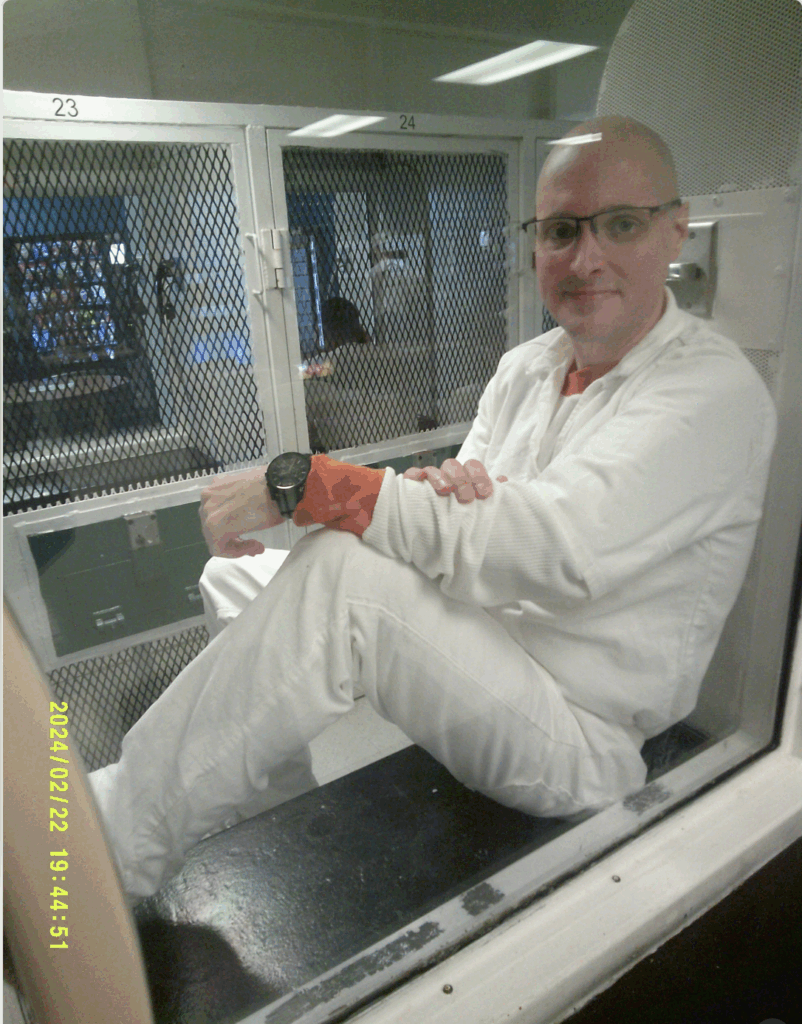
Over the six months that I spent in the CITP, I witnessed three cohorts of students graduate before me. The general rule was that it would take a little over a month for each person to be assigned and transferred to their new units. That was my expectation, that I would get my chain orders sometime in late November. When I had first arrived in the program, the wardens had insisted that my High-Profile tag wouldn’t impact my existence in any noticeable way. This had turned out to be true. That all ended on 23 October, a mere six days after graduation.
The chain list is usually called out by regular officers, usually from the first floor, and then word is repeated by prisoners down the tier (usually to the accompaniment of whoops). For me, word arrived via the arrival of an administrative lieutenant. I heard people on one-row announce this man’s arrival, but I was in the cell cleaning, and I gave it no real attention. This changed a little when the chorus informed me that this person was moving to three-row, but only in the minor sense of being casually curious as to which of my neighbors had gotten into some kind of trouble. I was surprised when I looked up from scrubbing the floor to find him staring at me through the bars.
“You’re on chain, Whitaker. How long you need to pack?”
I sat back and took a quick look around the cell. In truth, I had already started to organize my stuff for a move, though I hadn’t expected this news for weeks.
“Can I have half an hour?”
“You got it. I’ll tell the picket boss to leave the door open for a bit. I’ll meet you at the section door in 30.”
“You know where I’m going?”
“Nope. I just know it’s a special chain.”
This alarmed me. “Is anybody else on your list?”
“Just you.”
I mulled that over as I packed my belongings. There was only one reason for me to be on special chain, which was that bloody HP tag. I’m weary of being special in a place where that word always seems to mean something along the lines of: “about to get fucked over”, but in this instance I thought there might be an upside. Special chains are always A to B. This meant I was going to get in the van, and we were going to straight to my destination, rather than meandering around a quarter of the state for twelve hours picking up random prisoners from multiple units. It also meant that all of my property was coming with me, instead of the regular one bag, with the rest sent months later. The downside is that one is physically restrained like an ad-seg prisoner, rather than a GP one, with the dreaded black box, leg irons, and belt. Overall, I reasoned, maybe the tag wasn’t an entirely evil spirit haunting my existence after all.
I left my food for Catracho, and spent a couple of minutes roaming the tiers, saying goodbye to everyone. I knew this was likely to be the last time that I would see most of these guys. This is one of the least commented-on traumas of prison life, how one forms these tight relationships amidst miserable conditions, which are then torn asunder at random intervals. Still, population awaited, and I was eager to finally be a part of it.
The question remained: where was I going to be sent? None of the guards escorting me down the hallway knew. I was taken to the visitation area, where my property was catalogued. It wasn’t until I noticed an officer affixing labels to my bags that I learned which of the state’s roughly one hundred prisons was to be my new digs. I moved over to my bags and leaned over to see the designator “0054” in the paperwork. This was a number I knew well, but it stunned me, nonetheless. Of all of the units I had contemplated living in, I’d never once imagined this one. Former death row never got assigned there — and I mean never.
“Really?” I asked one of the transport officers, still in a state of disbelief. He looked up from his notepad and then nodded.
I was going back to Polunsky.
To be continued…
As many of you know, I started my second master’s degree in 2025, this time in psychology. My progress is slow, but I’m doing well so far. Below you can see a final exam grade, as well as my overall final grade for that course. I’m also including a page from this final, which my proctor gave to me.


I am still badly in need of a few of you to make some kind of donation to my [education fund]. I did have one person give an anonymous donation recently (thank you, whoever you may be!), but I am starting to get worried by the state of my finances. I have enough money to cover the next couple of courses, but unless something changes soon, I’m going to have to withdraw from the program. It had been a very long time since I asked the readership for any kind of assistance, and I’m hoping that a few of you long-term readers will find it in your hearts to be generous and help me to continue down this path. Many thanks in advance.



1 Comment
AJ
June 26, 2026 at 11:14 pmI hope you write again soon.